
A grid EA places trades across price levels. Martingale increases trade size after losses or an adverse sequence. A breakout EA enters when price moves beyond a defined level.
These labels describe different parts of a trading system, so they can overlap. A robot can use breakout entries, add grid orders and increase their size.
Before buying an Expert Advisor, check three things: what triggers an entry, how exposure changes and what closes a losing trade.
Quick comparison
| Type | What the term describes | Simple example | Main question to ask |
| Grid | Order placement across price levels | Several orders spaced along a price ladder | How many orders can accumulate, and where are losses cut? |
| Martingale | Position sizing after losses or adverse moves | A recovery sequence that increases trade size | How large can the next trade and total exposure become? |
| Breakout | Entry after price crosses a defined boundary | Buying above a recent range high | What happens if the break fails? |
There is no universal winner. A strategy label cannot tell you its account risk.
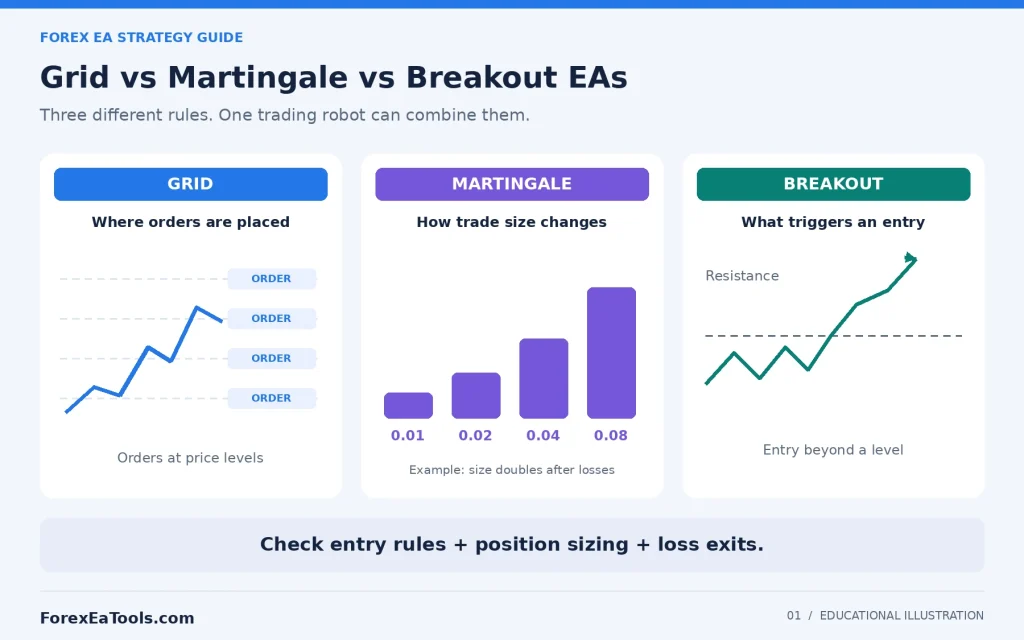
What is a grid EA?
A grid uses a series of price levels for placing orders. Spacing may be fixed or adjusted by rules.
In a common averaging grid, additional positions open as price moves against earlier entries. The system may aim to close the group after a retracement. This is one grid design, not a definition of every grid.
Check whether the EA adds into losses, adds into favourable moves, trades one direction or manages separate buy and sell groups.
A fixed-lot grid keeps each order the same size. That avoids a lot multiplier, but the total exposure still rises when another order opens.
Technical background: MQL5’s grid and martingale programming discussion.
What is a martingale EA?
Martingale-style sizing increases exposure after losses in an attempt to recover them. Doubling is a familiar example; other multipliers and capped sequences also exist.
It can operate through separate completed trades. It does not require several orders to remain open at the same time.
Imagine six losing trades with planned losses of:
$10 → $20 → $40 → $80 → $160 → $320
The completed losses total $630. Continuing the doubling sequence would require risking $640 on the next trade, before costs or broker constraints.
This is an arithmetic illustration, not a proposed trading plan. It does not assume that a winning trade must arrive.
Increasing size changes exposure. It does not make the next entry more likely to win.
What is a breakout EA?
A breakout EA uses a move beyond a defined boundary as an entry signal. The boundary could be a range high, range low or another programmed level.
For example, suppose price has been moving between 100 and 110. A system might look for a buy above 110. If price rises and then quickly falls back inside the range, the entry may have followed a false breakout.
Some systems wait for a closing candle, a retest or another condition. Those rules change which entries are accepted; they do not guarantee success.
See IG Academy’s explanation of breakouts and false breaks.
The word “breakout” does not establish lot sizing, stop placement or recovery rules. Check those separately.
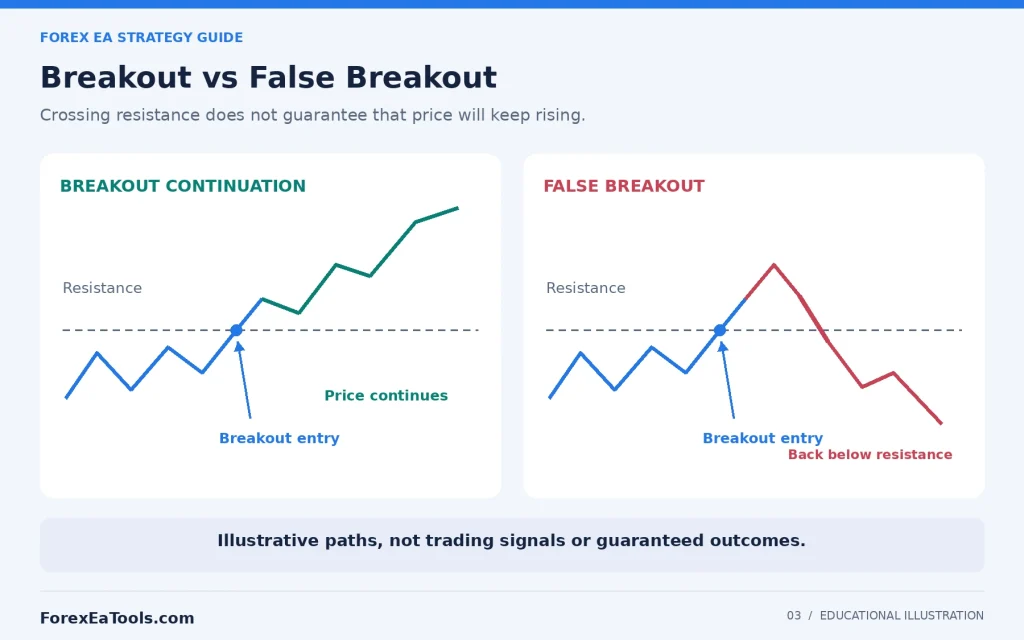
Can grid, martingale and breakout rules be combined?
Yes. Think of an EA as a set of independent decisions:
| Decision | Example |
| Entry | Buy when price breaks a recent high |
| Additional orders | Add at specified price distances |
| Sizing | Keep volume fixed or increase it after an adverse move |
| Exit | Close an individual trade, a basket or the whole account’s positions |
A breakout entry with increasing recovery lots still needs its escalation risk assessed. A fixed-lot grid still needs its accumulated exposure assessed.
The MQL5 Grid-Mart programming example illustrates how order placement and sizing rules can be combined, with configurable limits.
Worked example: fixed-lot grid versus doubling grid
This hypothetical Gold example shows how the same price path can produce different losses.
Assumptions:
- A USD account with a contract size of 100 ounces per lot.
- Five buy entries at 3,000, 2,990, 2,980, 2,970 and 2,960.
- Price then reaches 2,950.
- All five positions remain open.
- No costs, slippage, stop-outs or other orders are included.
Your broker’s contract may differ. These assumptions explain the calculation; they are not market prices or recommended settings.
| Buy entry | Fixed-grid lot | Open loss at 2,950 | Doubling-grid lot | Open loss at 2,950 |
| 3,000 | 0.01 | $50 | 0.01 | $50 |
| 2,990 | 0.01 | $40 | 0.02 | $80 |
| 2,980 | 0.01 | $30 | 0.04 | $120 |
| 2,970 | 0.01 | $20 | 0.08 | $160 |
| 2,960 | 0.01 | $10 | 0.16 | $160 |
| Total | 0.05 | $150 | 0.31 | $570 |
For each buy, the loss is:
(Entry price − Current price) × Contract size × Lots
For the first position: (3,000 − 2,950) × 100 × 0.01 = $50.
The fixed grid has a smaller loss in this particular comparison. It still carries five positions and $150 of open losses.
This example does not compare strategies with equal total risk. It isolates the effect of changing lot size while holding entry levels and price constant.
A position limit is not a loss limit
Suppose the fixed grid stops adding after five entries, but price falls another $10 to 2,940.
The five positions now lose $200 in total. A limit on order count did not stop existing losses from growing.
Also distinguish exposure growth from loss growth. Equal-size orders add equal units of exposure. While new orders accumulate, older orders continue losing, so the combined loss does not necessarily rise by equal amounts at each grid level.
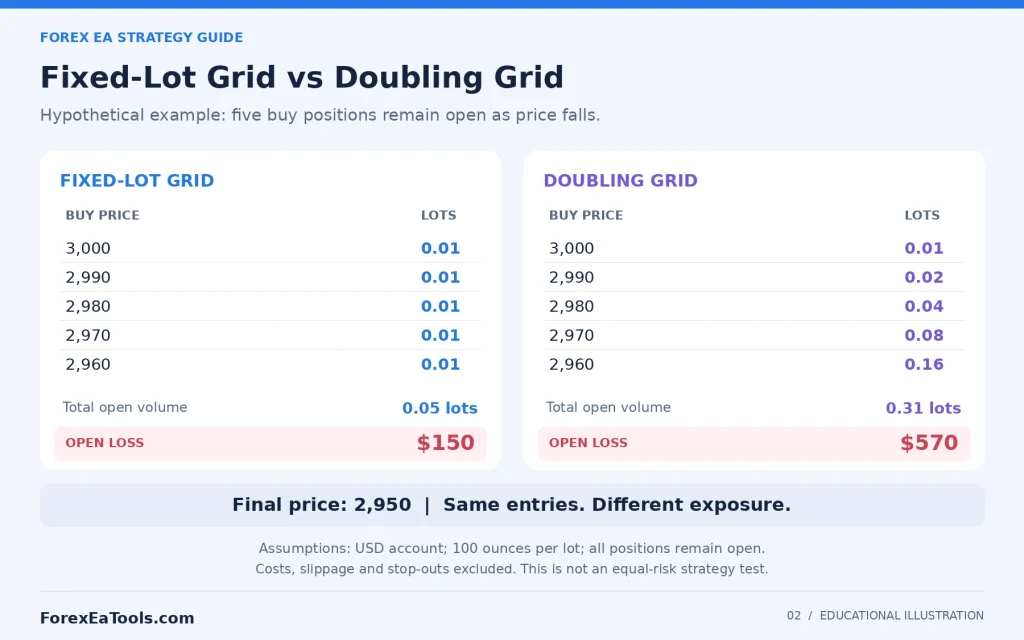
Can grids and martingale systems use stop losses?
Yes. A system can include individual stops, a basket stop or an account-level exit.
Their existence does not prove that the settings are practical. Establish what the stop measures, when it triggers and whether it actually closes positions or only prevents new entries.
A stop on each completed martingale trade also does not cap the loss across the whole sequence.
An ordinary stop loss is not a guaranteed fill at the requested price. Gaps or rapid moves can cause a worse execution price. Broker-specific guaranteed stops are separate products with their own terms.
Source: OANDA’s explanation of stop-loss slippage and guaranteed stops.
Which EA type is safer?
The category alone cannot answer that.
A configuration with clear exit rules, capped total exposure and no loss-driven escalation can be easier to assess. It can still lose money through poor entries, repeated losses, costs or execution differences.
A breakout EA with oversized trades can be more dangerous than its name suggests. A grid with small individual trades can carry more combined risk than its first order suggests.
Compare actual configurations under comparable assumptions. Do not compare a low-volume preset against an aggressive preset and attribute the result only to the strategy name.
What to expect in different markets
A common averaging grid may benefit from retracements, but a sustained move can leave it holding losses. Not every grid has the same directional behaviour.
A breakout system seeks movement beyond a boundary. Repeated failed breaks can create a losing sequence even when each trade has an exit rule.
Martingale does not define a favourable market condition by itself. It changes sizing around another entry and exit system.
Avoid assuming that a strategy will always work in a market described as “ranging,” “trending” or “volatile.” Those labels do not establish the quality of its rules.
Why a high win rate is not enough
Suppose an EA closes nine trades at a $10 profit each, then loses $150 on the tenth.
It has a 90% win rate and a $60 net loss, before costs.
Now suppose another EA wins four trades at $30 each and loses six at $10 each. Its 40% win rate produces a $60 net profit, before costs.
These examples explain arithmetic, not typical results for any EA category.
Check the size of wins and losses, open positions and exposure alongside the win rate.
Look at equity, not only balance
Balance mainly reflects completed trades and cash movements. Equity also includes open trading profits and losses, subject to the platform’s account treatment.
For example, a $2,000 balance with $600 of open losses has about $1,400 equity before other adjustments. The open loss is 30% of that balance. It is not automatically a 30% historical drawdown: that calculation needs the relevant previous equity peak.
Our guide to drawdown in forex trading explains the difference between balance and equity measurements.
A margin-use figure is another measurement. It does not show the same thing as drawdown or the amount an account could ultimately lose.
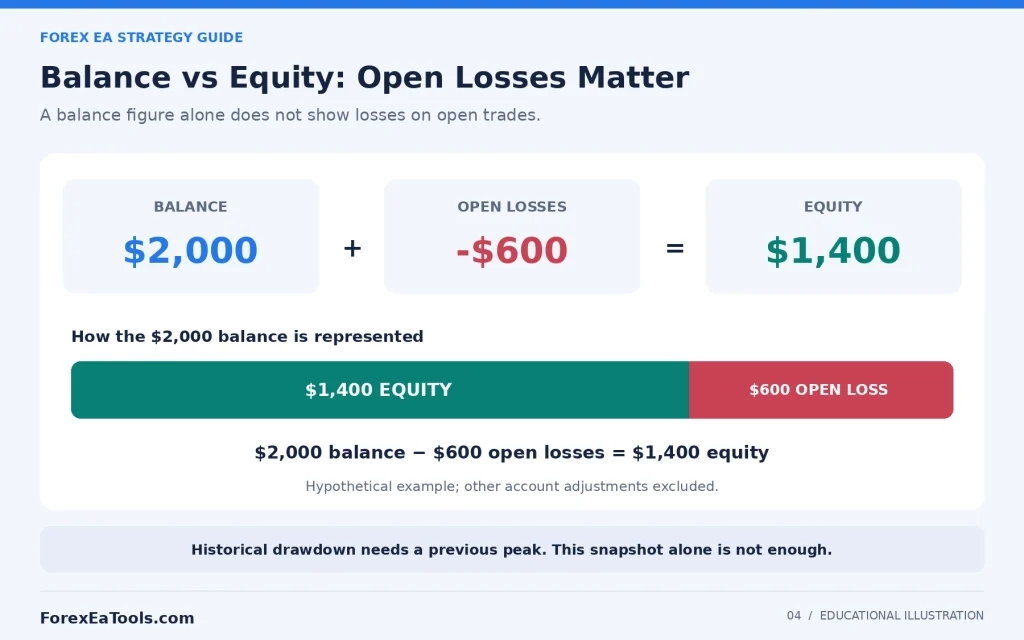
How to identify the rules inside an EA
Read its instructions and settings, then examine trade records under controlled test conditions.
| What you observe | What it may indicate | What still needs checking |
| Orders appear at repeated price distances | Grid-style placement | Spacing rules, direction and order limits |
| Size increases after losses | Recovery or martingale-style sizing | Trigger, multiplier, reset rule and maximum size |
| Entries follow range breaks | Breakout logic | Confirmation, failed-break exits and additional orders |
| Several trades close together | Basket management | It does not by itself prove grid or martingale |
| A recovery or multiplier input | Potential exposure changes | Input names alone do not establish behaviour |
An increase in lot size is not always martingale. For example, percentage-risk sizing may change volume when the stop distance changes. Check the calculation and sequence rather than judging one screenshot.
If the seller cannot explain how exposure increases or how losses are closed, you do not yet have enough information to assess the configuration.
Checklist before choosing an EA
- Entry: What conditions open a trade?
- Sizing: Can volume increase after a loss, and is there a cap?
- Total exposure: How many positions can operate together?
- Exit: What closes a losing position or group?
- Drawdown: Is the figure based on balance or equity?
- Evidence: Does the account or report match the version and settings?
- Execution: Were realistic costs and adverse market conditions considered?
- Account rules: Are the symbol, account mode and permissions compatible?
Our forex EA buyer checklist covers licence, delivery and support questions as well.
Testing and setup
Test the intended configuration without repeatedly adjusting it to improve its historical graph. Include periods that challenge its entry and exposure rules, and inspect open positions as well as closed profits.
A demo run can reveal setup problems and behaviour. It does not guarantee equivalent real-account execution.
If you use presets, follow the MT5 SET-file guide and review imported values. A different preset can change risk without changing the product name.
For platform steps, see how to install an EA in MT5.
Frequently asked questions
Are grid and martingale the same?
No. Grid describes placement across price levels; martingale describes increasing exposure following losses or adverse moves. They can be used separately or together.
Is every recovery EA a martingale EA?
No. Recovery is a broad label. Check whether it adds positions, increases size, changes exits or uses another rule.
Does “no martingale” mean low risk?
No. Large fixed lots, many simultaneous trades or weak exit rules can still create substantial losses.
Can a breakout EA use grid orders?
Yes. Its entry method does not prevent additional grid orders or recovery sizing. Inspect the complete rule set.
Is doubling the only type of martingale?
Classic examples double the stake. Products described as martingale-style may use other multipliers or capped progressions. Check the actual sequence.
Is every fixed-lot grid loss linear?
No. Exposure rises by equal units when equal-size positions are added. Combined losses also depend on how far each entry is from the current price.
Is a stop-loss value the maximum possible loss?
Not necessarily. Execution can differ from the requested price, and more than one position may lose. Assess the whole account and the broker’s order terms.
Are breakout EAs best for beginners?
The label is not enough to establish suitability. Beginners need understandable rules, practical testing access and clear risk information.
Does an AI filter remove these risks?
No. An AI label does not establish exposure limits or reliable execution. Check what the feature actually changes and what happens when it fails.
Can any EA guarantee a prop-firm pass?
No. Check the firm’s current rules and loss calculations before deployment. An EA or preset label does not establish permission or a successful outcome.
ForexEATools sells EAs and indicators. This guide explains how to assess strategy labels, including those on our own listings. It does not recommend a specific product or promise trading returns. Leveraged trading can result in significant loss.
